
Anticancer activity of phytocompounds of black ginger (Kaempferia parviflora Wall. Ex Baker): In silico approach
December 11, 2025 by Science Direct
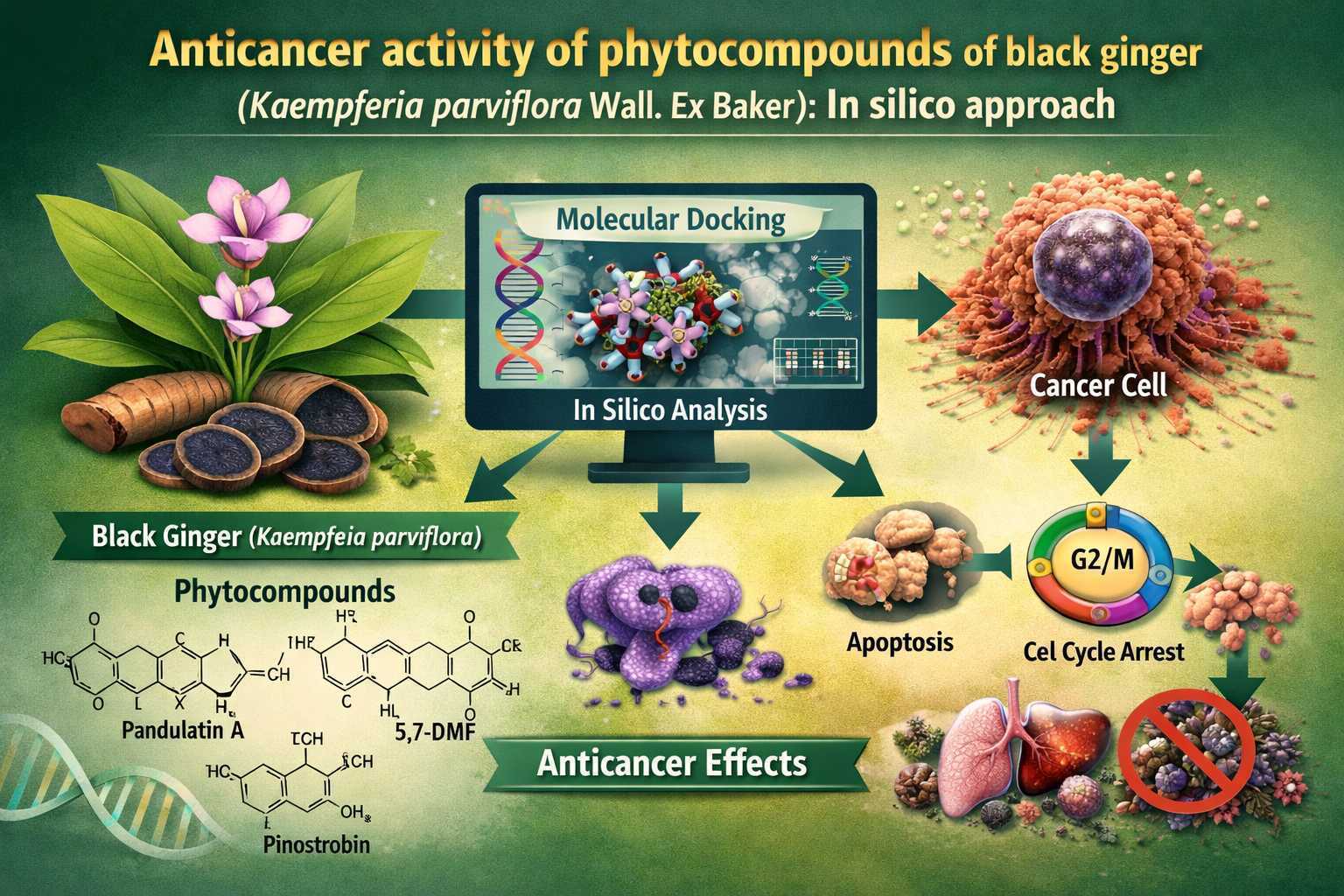
Highlights
- •KP1, KP2, Viscumneoside VI, and 5H7M showed the strongest interactions.
- •KP1 and Viscumneoside VI showed good affinity against five anticancer targets.
- •KP2 showed good binding affinity against six anticancer targets.
- •Phytocompounds exhibited interactions with amino acids similar to reference drugs.
- •Potential phytocompounds showed good in silico ADMET profiles.
Abstract
Background
The main components of black ginger (BG, Kaempferia parviflora Wall. Ex Baker) show diverse biological effects, especially potential anticancer activity. Furthermore, in silico computational approaches offer a powerful strategy for discovering novel therapeutic candidates from medicinal plants, providing an innovative solution to address the increasing global burden of cancer.
Methods
Tentative identification of phytocompounds of BG extracts was performed using the LC-MS method. Thirty-five phytocompounds of BG were screened using molecular docking with AutoDock Vina software against eleven anticancer targets.
Results
Five BG phytocompounds KP1, KP2, Viscumneoside VI, and 5-Hydroxy-7-methoxyflavone (5H7M) showed the strongest interactions with multiple anticancer targets compared to the reference drugs. KP1 showed good binding affinity (BA) against five targets (HDAC6 (−8.6 Kcal/mol), EGFR (−9.5 Kcal/mol), mTOR (−9.7 Kcal/mol), PI3K (−10.3 Kcal/mol), and PD1 (−7.9 Kcal/mol)). Meanwhile, Viscumneoside VI exhibited good BA against five targets (HDAC6, CDK2, EGFR, PI3K, and PD1 (−7.9 to −9.4 Kcal/mol)), and 5H7M showed good binding affinity against four targets (DHFR, PI3K, KDR, and PDL1 (−9.5 to 10.0 Kcal/mol)). In particular, KP2 showed good binding affinity and hydrogen bond (HB) formation against six targets, including KDR (−9.8 Kcal/mol) and five targets similar to KP1 (−8.3 to −9.9 Kcal/mol). Phytocompounds KP1, KP2, Viscumneoside VI, and 5H7M exhibited some interactions (HB, electrostatic, and hydrophobic) with amino acid residues of DHFR, HDAC6, CDK2, EGFR, PI3K, ALK, and KDR similar to the reference drugs. Furthermore, these phytocompounds showed good in silico ADMET profiles compared to anticancer drugs.
Conclusion
These potential phytocompounds need to be isolated, synthesized and researched more in-depth for the development of new cancer drugs, especially KP1 and KP2.
